
Why Does Hair Grow Back After Laser Hair Removal?

Why does hair grow back after laser hair removal, and does regrowth mean the treatment didn’t work? Hair can return for several reasons, many of which are connected to the natural hair growth cycle and the way different follicles respond to laser treatment. In this article, we’ll explain what can cause regrowth, which factors may affect your results, and when maintenance treatments may be worth considering. If you’re looking into laser hair removal treatment in North Vancouver, understanding these factors can help you know what to expect from your treatment over time.
Does Hair Grow Back After Laser Hair Removal?
Yes, some hair can grow back after laser hair removal.
Laser treatment works by delivering energy to the pigment in the hair. That energy is converted to heat and affects the follicle responsible for producing the hair. However, the response of individual follicles can vary, and not every follicle is equally vulnerable at the time of a treatment.
When hair does return after successful treatment, it may be less noticeable than the original growth. In some cases, regrowing hair may appear finer or lighter, although individual results vary.
This is why laser hair removal is better understood as a method of long-term hair reduction rather than a guarantee that every treated area will remain completely hair-free forever.

The Hair Growth Cycle and Laser Hair Removal
One of the biggest reasons for hair regrowth after laser hair removal is the natural hair growth cycle. Individual hairs do not all grow at the same time, and follicles move through different stages.
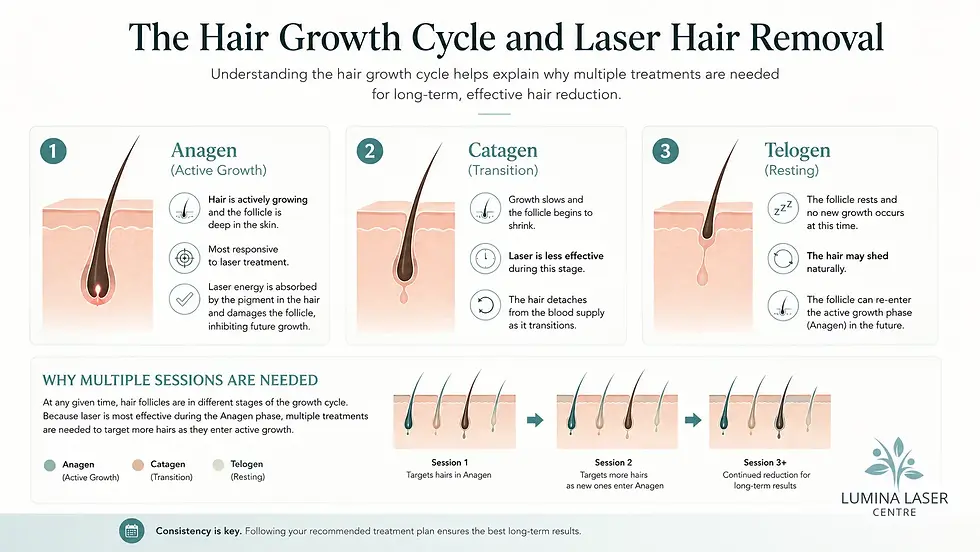
Because different follicles are in different stages at any given time, a single treatment cannot target every potential hair under the same conditions. This is why laser hair removal is typically performed over a series of appropriately spaced treatments.
Why Does Hair Grow Back After Laser Hair Removal?

Several factors can contribute to visible hair appearing again after treatment.
1. Some Follicles Were Not in the Active Growth Phase
A follicle that was dormant, resting, or transitioning during a previous appointment may later enter an active growth phase. When that happens, hair can become visible in an area that previously looked much smoother. What appears to be hair suddenly “coming back” may simply be different follicles moving through their natural growth cycles at different times.
2. Not Every Follicle Responds in Exactly the Same Way
Hair characteristics vary from follicle to follicle and from person to person. Hair colour, thickness, skin characteristics, treatment area, laser settings, and individual response can all influence the outcome of laser hair removal. This is one reason treatment plans should be personalized rather than based on the assumption that everyone will experience exactly the same results.
3. Hormonal Factors Can Influence Hair Growth
Hair growth is also influenced by hormones. Changes in hormonal activity can affect how and where hair grows, including after someone has previously completed laser treatments. In some cases, follicles that were not producing noticeable hair before may later become more active. Laser hair removal can address the visible hair being treated, but it does not control the underlying hormonal processes that influence future hair growth.
If you experience a sudden or significant change in your normal hair-growth pattern, discussing it with an appropriate healthcare professional may be helpful.
4. Different Body Areas Can Behave Differently
Hair on the face does not necessarily behave exactly like hair on the legs, underarms, back, or bikini area. Different areas have different hair characteristics and may also respond differently to hormonal influences. As a result, the amount and timing of regrowth can vary depending on the area being treated.
This is another reason there is no single timeline or outcome that applies to everyone.
Hair Regrowth Does Not Necessarily Mean You Are Starting Over
Seeing a few hairs return after laser treatment is different from having all of your original hair growth return exactly as it was before. After a successful course of treatment, some people notice that any returning hair is:
less dense
finer
lighter
slower or less noticeable than before
Results still vary from person to person, so these changes should not be treated as a guaranteed outcome. It is more useful to evaluate your overall reduction and growth pattern rather than judging the treatment based on an occasional individual hair.
Why Does Laser Hair Removal Need Multiple Sessions?

The answer comes back to the hair growth cycle. Because laser treatment works most effectively on actively growing hairs, appropriately timed appointments provide opportunities to treat additional follicles as they enter that stage.
This does not mean everyone requires exactly the same number of treatments. Your treatment area, hair characteristics, skin type, response to previous sessions, and individual growth cycle can all influence your treatment plan. At Lumina Laser Centre, treatment plans are adjusted to individual skin and hair characteristics rather than relying on a one-size-fits-all approach.
What About Hair That Appears Soon After a Laser Session?
Not everything that looks like new growth immediately after treatment is necessarily new hair. Treated hairs do not always disappear immediately. They may remain visible for a period before gradually shedding over the following days or weeks. This can sometimes make it look as though hair is continuing to grow shortly after treatment.
If you are unsure whether what you are seeing is expected shedding or actual regrowth, your laser provider can assess the area and your treatment timeline.
Will You Need Laser Hair Removal Maintenance?
Possibly, but not everyone will have the same maintenance needs. Over time, some people may notice enough new or returning growth that an occasional maintenance treatment makes sense. Others may experience relatively little noticeable regrowth for longer periods. Maintenance treatments can sometimes be useful when noticeable hair returns after an initial course of laser hair removal.
Factors that may affect laser hair removal maintenance include:
your natural hair growth pattern
the area treated
hair thickness and colour
hormonal influences
your response to previous treatments
how much regrowth you personally consider noticeable
Instead of assuming maintenance should happen on a fixed schedule, it is usually more useful to evaluate your actual regrowth and discuss it with your provider.
Can You Prevent Hair From Ever Growing Back?
No responsible provider can promise that every treated hair will disappear forever. Laser hair removal can significantly reduce unwanted hair, and results may last for extended periods, but some regrowth remains possible.
Rather than thinking of laser treatment as a guarantee of permanent, completely hair-free skin, it is more accurate to think in terms of long-term reduction and easier management of unwanted hair, with maintenance considered when appropriate.
Personalized Laser Hair Removal in North Vancouver
Your hair growth cycle, skin type, hair characteristics, treatment area, and personal goals all play a role in determining the right approach. Lumina Laser Centre uses Soprano Titanium technology and creates individualized treatment plans based on each client's skin and hair characteristics.
If you are considering laser hair removal treatment in North Vancouver, a personalized consultation can help you understand what kind of reduction may be realistic for your hair and what an appropriate treatment plan could look like.
Conclusion
So, why does hair grow back after laser hair removal? Hair regrowth can be influenced by the natural hair growth cycle, dormant follicles, hormonal changes, and individual treatment response. Some regrowth does not necessarily mean the treatment failed, as laser hair removal is designed for long-term hair reduction rather than guaranteed permanent removal. Lumina Laser Centre can help you explore an approach suited to your hair and treatment goals.



Comments